Monday, 24 January 2011

SECTION TWO: RESEARCH INTO COMPARABLE MEDIA PRODUCTS

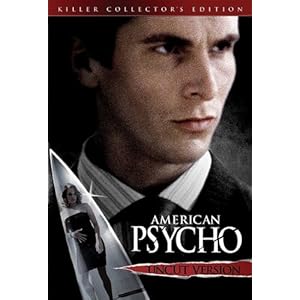
'AMERICAN PSYCHO' : OPENING SEQUENCE ANALYSIS


1) Entire room is white - this plays on the stereotypical relation between the colour white and innocence. The title 'American Psycho' and the narrative (involving vicious murders) does not correlate with the 'white colour scheme'. This represents the idea that 'not everything is as it seems'.


2)Everything is immaculate - this shows us the characteristics of whoever lives here, for example: obsessive about cleanliness/appearance


3)We also see a telescope in the room - this shows the character is intellectual


4) The walls have blank photo frames hung on them - this creates and eerie setting and also represents a lonely character.


5)During this scene a high tempo piano is playing - this creates suspense and emotion


6)Our first facial shot of the male character is his reflection in a picture hung on his wall - this shows he is content with himself as he can "look at himself in the mirror". This is anchored by his speech that is playing during this scene: "I believe in taking care of myself".


7)In the shower he discusses his vast amount of different products and the precise order he uses them - this anchors the 'obsessiveness' of his character shown before through the cleanliness of his apartment. 


8)At the end of the scene he describes not being who you think he is. This is anchored by the odd white colour theme (discussed in point one). Also, whilst he says this the piano has stopped leaving an eerie silence and he peels of a face mask. This connotes the revealing of his true self and represents him wearing a 'mask' of normality. (This is anchored later in the film when he states "my mask of sanity is starting to slip").
SECTION TWO: RESEARCH INTO COMPARABLE MEDIA PRODUCTS

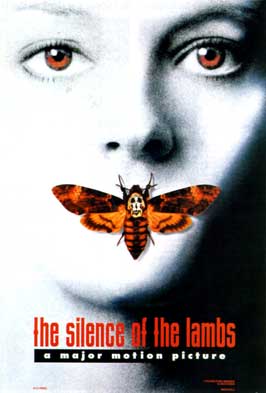
'SILENCE OF THE LAMBS' : OPENING SEQUENCE ANALYSIS

1)Black trees contrast to pale white sky - this creates eerie, ominous setting. 

2)The trees have no leaves - this shows the season that the film is set in, and also connotes death which in-turn foreshadows the narrative.

3)The forest connotes uncertainty as it is a 'labyrinth' with many unseen/dangerous places.

4)Our vision of the scene is obscured by mist - this creates enigma as we are not entirely sure what we can see.

5)Before we see the female character appear a loud sound of heavy breathing is heard - this shocks the audience and presents the question "who or what is making the sound, and why?" 

6)We then see a female character running - this adds to the enigma as we are unsure as to why she is running, perhaps running away from someone?

7)The camera shot follows the female character creating the impression that someone is watching her or following her.

8)The music reaches a crescendo as she runs before stopping when her name is called - this creates suspense and tension, and provides a sort of 'cliff-hanger'

9)On a tree a sign reads "Hurt.Agony.Pain.Love it" - not only does this show character (she will be used to dealing with these emotions) but also foreshadows the narrative, that the characters will go through some sort of 'hurt, agony or pain'

10)As the female character makes her way up to see her boss, the different levels have different characters. For example, the first floor has an even ratio of men to women. However once she enters the lift to go 'higher up', only males are seen. This is further shown by all the males being dressed in red whilst the single female character is all in grey. That could also connote her character as stereotypically grey is a more masculine colour and red a more feminine, thus showing she tries to 'man-up' in order to 'fit in'.

SECTION TWO: RESEARCH INTO COMPARABLE MEDIA PRODUCTS

'JAWS' : OPENING SEQUENCE ANALYSIS
The first thing we see is a black screen. This instantly creates enigma as the question arises 'why can't we see anything?'. This is accompanied by both diagetic (sound of the water) and non-diagetic sound (mood music). The 'mood music' is very sharp and low-key. This creates suspense and tension. The diagetic sound of the water foreshadows the setting to follow (underwater) and also foreshadows the narrative as the storyline is based upon an 'underwater fiend'. As the music gains a faster tempo, the scene of underwater is presented. The camera shot seems to move through the water, representing the sharks line of vision. The music reaches a crescendo creating the impression that something is about to happen, however the shot then cuts to a relaxed teenage beach scene. This creates confusion and in turn, suspense, as the audience doesn't know what to expect. This could also represent Jaws 'heading towards his victims'.


As the camera moves through the group we see a closeup of a boy who is facing the opposite way from the entire group. This singles out the importance of his character within that group. The camera then follows his line of vision showing us a female character sat on her own, outside the circle of friends. This connotes danger for her character as she is not within the group due to the stereotypical belief of 'safety in numbers'. The setting of the beach at night enforces the sense of danger as the characters are more vulnerable at night-time and on a secluded beach surrounded by ocean. 

When the two characters run off together towards the ocean, the boy is shown to be drunk (eg- repeatedly falling over, he also says "I'm not drunk!" with a beer can in his hand). This immediately shows the audience that he is somewhat accident prone due to his inebriation. This foreshadows the 'accident' that will occur to Chrissie (female character) soon. As Chrissie enters the water, a shot of her from underwater is shown, representing Jaws' vision. This 'warns' the audience that something is about to happen. This is enforced by the change in sound above and below water shots. Above the water only diagetic sounds from the characters and the water is heard, however under the water non-diagetic ominous music is played creating enigma and foreshadowing narrative. This ominous music continues into the above water shots once Jaws has started to attack Chrissie. Before Chrissie is attacked, an establishing shot of the ocean is shown, to show the audience her vulnerability of being alone in the vast ocean with Jaws. Once Chrissie has disappeared under the water there is no music or sounds except for the water lapping. This creates an eerie atmosphere and lets the event sink into the audience, creating the 'persona of Jaws' to be an evil murderer. However some audiences may not perceive Jaws this way and see the death of Chrissie as inevitable due to the nature of the shark. 

SECTION TWO: RESEARCH INTO COMPARABLE MEDIA PRODUCTS

'SEVEN': OPENING SEQUENCE ANALYSIS


Atmosphere:


- Gloomy, Dull, Grimy, Oppressive.


Created through:
1)Weather. It is raining which immediately 'dampens' the atmosphere in contrast to if it was sunny.
2)Setting. The House is dirty and grubby, with monotone colours such as grey.
3)Lighting. Low Key, Dark lighting.
4)Narrative. A murder scene creates a sombre atmosphere instantly.


Themes/Ideology


-The law


Created through:
1)Setting. Bars all around the building connotes prison/jail. Can also connote being trapped inside or someone being locked out.
2)Sound. Diagetic police sirens in the background of the apartment. Denotes police, crime, the law, etc.


Character: Somerset


-Cognitive:
1)He asks"did the kid see it" (in reference to the murder). The other officer reacts in a way that dismisses the comment and states that he thinks Somerset thinks too much about the case and should just get the job over and done with.
2)He lies in bed listening to a metronome. The sound of the metronome connotes his thoughts 'ticking over' in his head


-Well Educated
1)His apartment is full of shelves of books


-Experienced, used to crime
1)Unfazed by the sounds of sirens in the background and sounds of neighbours fighting. Also unfazed by the weaponry (knives) that are part of his uniform
2)Follows a routine when he gets ready. His uniform is laid out in a specific order. This connotes being so experienced at his job that he perhaps doesn't need to think twice about what he's doing whilst getting ready, it is second nature to him.


-Lonely
1)Absence of a partner in his apartment. Empty side of his bed with two lampshades either side as if one would have been for his partner.


-Optimistic
1)His belongings are looked after and stored neatly in a specific order. This contrasts to the grubbiness of the apartment, showing that he makes the most of what he has.


Character: Mills


-New to the area/job
1)Boxes of belongings in the apartment connotes that he has just moved in
2)His work shirt is creased and has no routine when getting ready. This contrasts to Somersets 'experienced' character


-Eager/excited
1)He is first at the crime scene waiting for Somerset with coffee. Shows he is eager to start. Could also show that he is new to the job therefore has to wait for the experienced character, eg 'respect for your elders' scenario.


-Upfront/Honest
1)"what you see is what you get" attitude implied by clothing. Somerset wears a hat, creating shadows on his face in-turn creating enigma about his character. Whereas Mills has nothing hiding his face.


-Under pressure
1)He is shown to have a female partner. He could be under pressure to provide for her as she seems to rely on him. This is shown through the body language of the bed scene as she is lay across him 'leaning' on him. This also contrasts to Somersets lonely home.


Sound


-Distortion in the music
1)Connotes Johns (the murderer) frame of mind as distorted/mentally ill.


-Loud Beats
1)Connotes heartbeats, representing the theme of life and death.


Theme of Death


1)Images of dead people/murders in the opening title sequence.
2)Opens with the characters going to a murder scene
3)Black and red are the predominant colours in the opening title sequence. These colors connote 'evil' and 'death'.

SECTION ONE: THE THRILLER GENRE

DEFINITION: These are types of films known to promote intense excitement, suspense, a high level of anticipation, ultra-heightened expectation, uncertainty, anxiety, and nerve-wracking tension. Thriller and suspense films are virtually synonymous and interchangeable categorizations, with similar characteristics and features.


- [http://www.filmsite.org/thrillerfilms.html]


There are eight primary elements of the Thriller genre:
  1. The central protagonist(s) faces death, their own or someone else's.
  2. The force/s of antagonism must initially be clever and/or stronger than the protagonist.
  3. The main storyline for the protagonist is either a quest or the character who cannot be put down.
  4. The main plot line focuses on a mystery that must be solved.
  5. The film's narrative construction is dominated by the protagonist's point of view.
  6. All action and characters must be credibly realistic/natural in their representation on screen.
  7. The two major themes that underpin the Thriller are the desire for justice and the morality of individuals.
  8. One small but significant aspect of a great thriller is the presence of innocence in what is seen as an essentially corrupt world.
- [http://www.twelvepoint.com/?q=blog/8-primary-elements-thriller-genre]


Thriller sub-genres:
Here are a few examples of thriller sub-genres:


Legal Thriller: eg- A Few Good Men
Disaster Thriller: eg-  The Day After Tomorrow
Psychological Thriller: eg- The Talented Mr. Ripley 
Medical Thriller: eg-  The Experiment
Religious Thriller: eg- The Da Vinci Code
Crime Thriller: eg - Silence of the Lambs
Techno Thriller: eg-  The Matrix

THRILLER THEORIES:

Partial Vision
This is where only some of the narrative information is given, leaving the audience to wonder what is going to happen next. This gives a chance for the audience to think of their own theories about what is going to happen in the film. Se7en is a great example because the audience only see the murder scene, not the murder happening.

Question Answer Model
This keeps the audience asking questions. These are mainly used in mystery thrillers as there could be a sort of surprise coming up at or towards the end.

The Transformed City
The transformed city is the idea that an ordinary place being transformed into an extraordinary place for the purpose of a thriller. Most Thrillers are set in a town or a city and for the thriller to be successful the atmosphere must change to become more different to others and more exciting.

Concealment and Protraction
Concealment and Protraction tends to pull the audience in different directions. It is used to create suspense and deliberatly hiding information. Protraction is also used to create suspense. For example this could be delaying a bomb explosion in a big city, the audience knows what is going to happen but suspense is created by hiding information.

Mazes and Labyrinths
This is the idea that the Protagonist finds themselves having to go through 'mazes' to reach the ending. The narrative of the film is usually filled with twist and dead ends, this makes it difficult for the Protagonist to resolve. The audience is always presented with the problems that the Protagonist must solve and how they do this.

The Exotic
This is the idea that buildings and objects have been placed within a Thriller which an audience would not expect to see at all. These objects could reflect personality? Sometimes there will be props from other places added to create a different setting or surrounding.

The Heroic Romance
The Protagonist of the film is shown to be an ordinary person but acts in heroic ways to survive during the film. In Thrillers the hero is usually portrayed as having an ordinary job and an ordinary life.